The Center for Cosmetic Surgery
725 Heritage Road #100
Golden, CO 80401
Phone: (303) 278-2600
Monday – Friday: 8 a.m.–5 p.m.
The Center for Cosmetic Surgery
755 Heritage Road #100
Golden, CO 80401
Phone: (303) 279-6100
Monday – Friday: 8 a.m.–5 p.m.
The Center for Cosmetic Surgery
501 South Cherry Street #900
Denver, CO 80246
Phone: (303) 951-2100
Monday – Friday: 8 a.m.–5 p.m.
The Center for Cosmetic Surgery
501 South Cherry Street #900
Denver, CO 80246
Phone: (303) 951-2102
Tuesday – Friday: 8:00 a.m.–5 p.m.
The Center for Cosmetic Surgery
6985 Tutt Blvd Ste 110
Colorado Springs, CO 80923
Phone: (719) 380-1823
Monday: 10 a.m.–1 p.m.
Tuesday – Friday: 8 a.m.–5 p.m.
- Step 1: Facelift Surgery Goals
- Step 2: Making the Incision
- Step 3: Creating a Pocket
- Step 4: Understanding the Layers
- Step 5: Trimming and Tightening
- Step 6: Improving Jaw Definition
- Step 7: Firming the Neck
- Step 8: Removing Extra Skin
- Step 9: Placing Fine Sutures
- Step 10: The Final Result
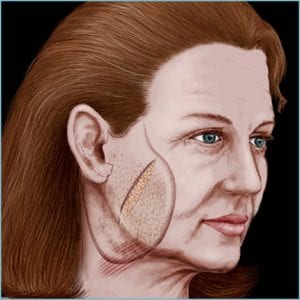
Most modern facelift techniques tighten the underlying SMAS layer to support the face from beneath, enhance the longevity of the rejuvenation, and reduce scar tension and widening. Although there are several methods to achieve SMAS elevation, the exact approach is not important as long as the technique is performed well.
During the mini facelift procedure, our Denver, Colorado, surgeons use a SMASectomy and plication technique to tighten and elevate the face. An ellipse of SMAS is trimmed out of the face (SMASectomy). This ellipse is parallel to the nasolabial folds and marionette lines so that a perpendicular pull on these creases is achieved when the edges are sewn together (plication).
This is an extremely safe technique for tightening the SMAS, as the nerves beneath it control facial movements. The technique poses no risk to the nerves. Therefore, our surgeons can report confidently that they’ve never caused a temporary or permanent facial nerve paralysis in any patient.
Mini Facelift vs. Traditional Facelift
The common method used for a traditional facelift requires surgery beneath the SMAS layer, exposing nerves to potential injury. The SMAS plication technique used during a mini facelift is equally effective, supporting the elevation of the SMAS layer, without the possible increased risk of nerve injury.
Step 6: Improving Jaw DefinitionMaking your cosmetic goals a reality is easier than ever with our flexible financing options:
Learn More About Financing Options